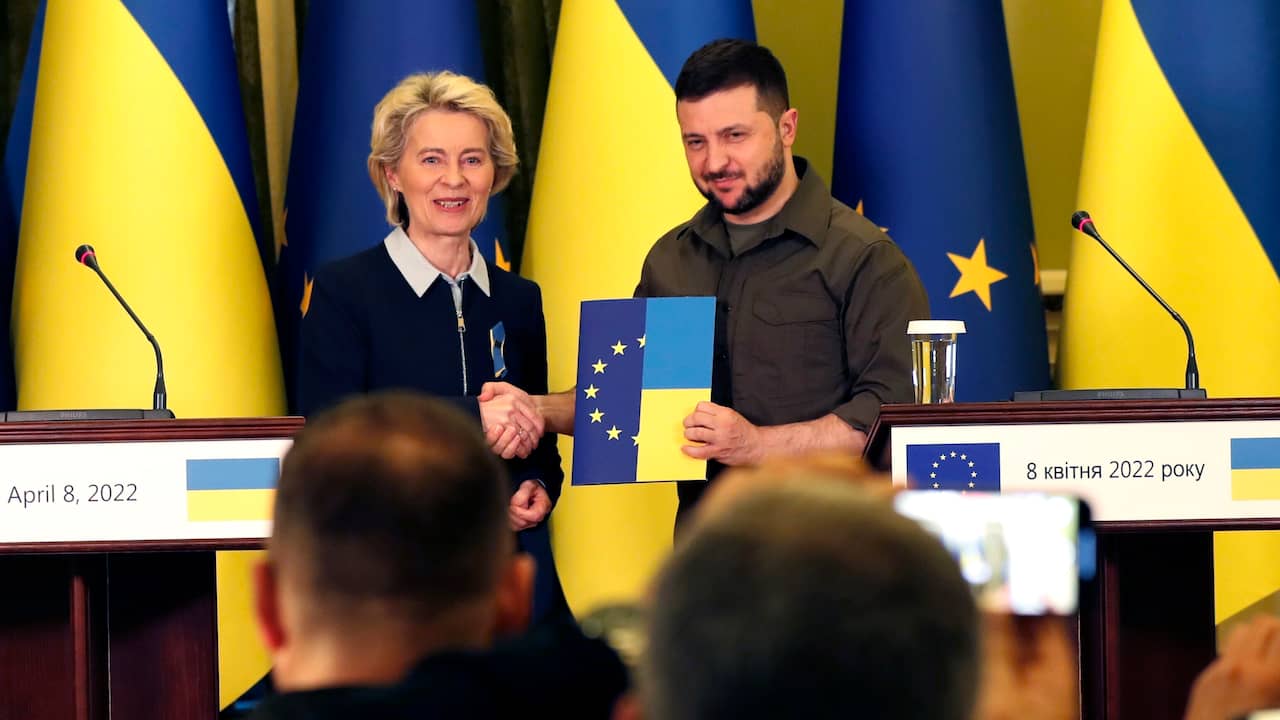
Ursula von der Leyen, the president of the European Commission, promised Ukrainian President Volodymyr Zelensky on Friday that Ukraine will accelerate the process of joining (or not) the European Union. Yet it remains unrealistic that the country will become part of the EU in the short term, professor of EU law Fabian Amtenbrink told NU.nl.
Von der Leyen gave Zelensky an envelope containing a questionnaire that forms the starting point for the EU to decide on membership. If it were up to her, that process will take "not as usual years, but weeks." According to Amtenbrink, the envelope and its contents were symbolic, but the signal that von der Leyen wanted to send is clear: "Namely that the EU is indeed taking steps towards Ukrainian membership."
A lot of steps still need to be taken before a country can join the EU. "That is a process that, in the best case scenario, can easily take five to ten years," says Amtenbrink. Moreover, it is ultimately up to the 27 EU member states to decide unanimously on the possible admission of Ukraine, and not to von der Leyen and the European Commission (EC).
According to the professor, what the EU can do relatively quickly is give Ukraine candidate member status.
Such a candidate status does not automatically entitle you to eventual membership, but the EU can send out a strong political signal.
But before the 27 EU countries vote on a possible candidate for membership for Ukraine, EC advice is required first. This process normally also takes one and a half to two years, although no specific time period is mentioned in the EU rules, according to Amtenbrink.
The EU could therefore choose - if it really wanted to - to shorten the process extremely. This would then be a political choice, but one that could create a precedent (an earlier decision, which another party can later rely on, ed.), Amtenbrink points out.
It remains to be seen whether the EU will proceed with such an accelerated assessment. Because although von der Leyen talked with Zelensky at the press conference on Friday about "a process of weeks", the statement of the chairman that the EC published on its website afterwards was already a lot more nuanced. It describes the delivery of the envelope as "the basis for our discussion in the coming months".
Ukraine must become a stable democracy
Should Ukraine eventually achieve candidate status, the next step will be full EU membership. To do this, the country must meet a whole list of admission requirements. For example, the country must become a stable democracy and have a functioning market economy, as well as a constitutional state that protects human rights.
In addition, a country must adapt its laws to all EU standards as we also know them in the Netherlands.
It's not finished yet.
Once the entire procedure has been completed and the EC has once again issued a positive advice about a country, all 27 member states must still unanimously approve the accession, according to Article 49 of the EU Treaty. After that, the European Parliament must do the same and then all countries must also ratify (ratify) the accession treaty. In other words: "An extremely lengthy and difficult process", according to Amtenbrink.