A little bit of background: what today is known as the Federal Republic of Germany or Bundesrepublik Deutschland was founded at the 23th May of 1949. It always had that name, but international it used the label "Made in West-Germany." Its communist counterpart, the German Democratic Republic (DDR was the German abbreviation for Deutsche Demokratische Republik) was founded at the 7th October of 1949. Bonn was the capital from West Germany until the Reunification, then it was changed to Berlin.
When talking about international public law the subject is older, it was founded at the 1st January of 1871.
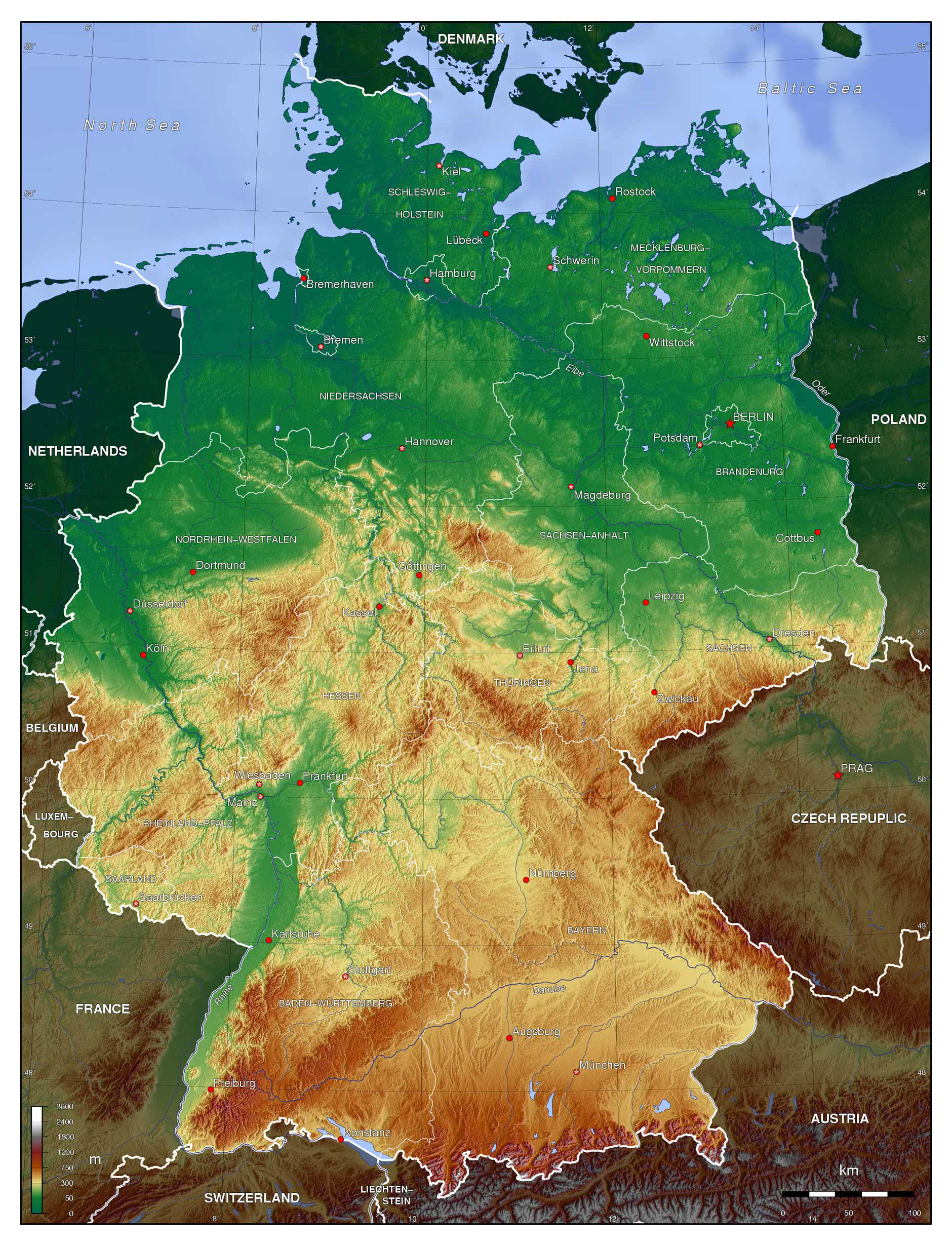
Germany has today about 83 million inhabitants, which is slowly growing because of immigration. It is the 3rd largest economy on the planet in terms of nominal GDP. Noteworthy ethnic minorities with special rights and own language are the Danes and the Sorbs. Germany has about 357,596 km² of area, and an average population density of 234 inhabitants per square kilometer. There are internal differences, but it is one of the most highly densly populated countries in Europe, but not as much as the Netherlands. The losses of WWI and WWII shaped todays' borders, before the area was bigger - it were 540.858 km² in 1914.
Big parts were handed over after WWI and WWII to Czechoslovakia, Poland and Russia (Königsberg/Kaliningrad today). With the 2+4 treaty enabling the reunification also Germany confirmed this regulation again, after it did already in the 1970s.
Germany can be from north to south divided in three different types of landscape: in the North it has access to the North and Baltic Sea, so it is really flat. Just like in the Netherlands or Denmark.
Somewhere in the middle the landscape is dominated by different low mountain ranges, like the Harz, Thüringer Wald, Schwarzwald and so on.
In the far south then it has access to the Alps.
It is a federal parliamentary republic, where thje head of state only has no real power, he only represents it and is elected for 5 years. He can serve at most 2 terms. At federal level, often called Bund (of Bundesrepublik) the head of government is the chancellor or Bundeskanzler.
Germany consists of 16 federal states. 5 joined in 1990 after the unification with the GDR. Each federal state has its own regional parliament together with own prime minister (Ministerpräsident) and government. As lesson learned from the Third Reich the task of overseeing press and public education is not located at Federal level, but each federal state.
Each state then again consists of counties, towns and villages. Several counties are usually bundled into a Bezirk, an administrative district.
At federal level there are two chambers of the parliament, the Bundestag and Bundesrat. The Bundestag is the federal parliament. If a planned law of the Bundestag affects the federal states, then it needs to be heared in the 2nd chamber Bundesrat as well, which consits of delegates of the administrations of all 16 federal states. 3 of the federal states are just cities, so they are called Stadtstaaten or city states - these are Bremen (which to add more confusion consists of 2 cities, Bremen and Bremerhaven), Hamburg and Berlin.
The federal parliament is using Mixed-Member Proportional Representation (MMP), as most other parliaments as well.
Contrary to France, where the whole country resolved around Paris and is quite centralised, Germany is really spread out all over the country more or less evenly.
The current Bundeskanzler (chancellor) is Friedrich Merz of the CDU or Christlich-Demokratische Union (christian-democratic Union), which is the major conservative party. Other noteworthy parties are the Sozialdemokratische Partei Deutschlands (SPD), which is social democratic with left-leaning tendencies, the Freie Demokratische Partei (FDP), who are economic liberals, the Bündnis 90/Die Grünen or just Die Grünen (Green Party, a party which roots in the anti nuclear power movement of the 70s and peace movement), die Linkspartei (Left Party, who are on the left side of the political spectrum and have their roots in the old state party of the GDR), and since 2013 the rising star Alternative für Deutschland (Alternative for Germany), which started as party of neoliberal economic professors, but nowadays is a reservoir of conservatives disappointed by the CDU up to the far right. One discussion at the moment is if this party should be forbidden due to its right wing tendencies to overthrow the state.
The main area of German being the main spoken language is often referred to as D-A-CH (Dach is by the way also the German word for roof), which is Deutschland, Österreich (Austria) and Schweiz (Conföderatio Helvetica).
There are also some German spoken areas in France, the Alsace region and in Belgium, also Luxemburg has it as official language.
Germany has the biggest number of non-native English speakers in Europe at around 56%.
Contrary to the UK Germany scrapped its nobility in 1918. Old ranks are still there, but just part of the regular names now.
Until WWI the Kaiserreich used the melody of the UK's hymn "God save the King" for its own hymn named "Heil dir im Siegerkranz." It was then changed during WWI.
The biggest domestic challenges at the moment are rearming the Bundeswehr (national army), reparing the rotting away infrastructure, integrating millions of refugees from Syria and Ukraine, solving the pension and health care problems, as well as the housing crisis and restarting the economy. Also preventing the AfD from getting in power.
Due to its history in WWII modern Germany sees itself as very close ally to Israel.
The major lesson learned from WWII, and also one of the goals of American reeducation back then was "Nie wieder Krieg, nie wieder Täter sein" - or never again war, and never again doing evil things. Which still has a big profound impact on modern decision making in politics.
When in 1955 the Bundeswehr was founded, only 10 years after the WWII capitulation, the majority of West Germans back then saw this as a bad thing. And for a long time there was a deeply rooted antipathy and distrust against the own army, which many still do held up until today.
It's only because of the Ukraine war that this recently changed, and Germany has started its biggest arms buildup in history since 1949.