


Argent Stonecutter
Emergency Mustelid Hologram
- Joined
- Sep 20, 2018
- Messages
- 7,681
- Location
- Coonspiracy Central, Noonkkot

- SL Rez
- 2005
- Joined SLU
- Sep 2009
- SLU Posts
- 20780


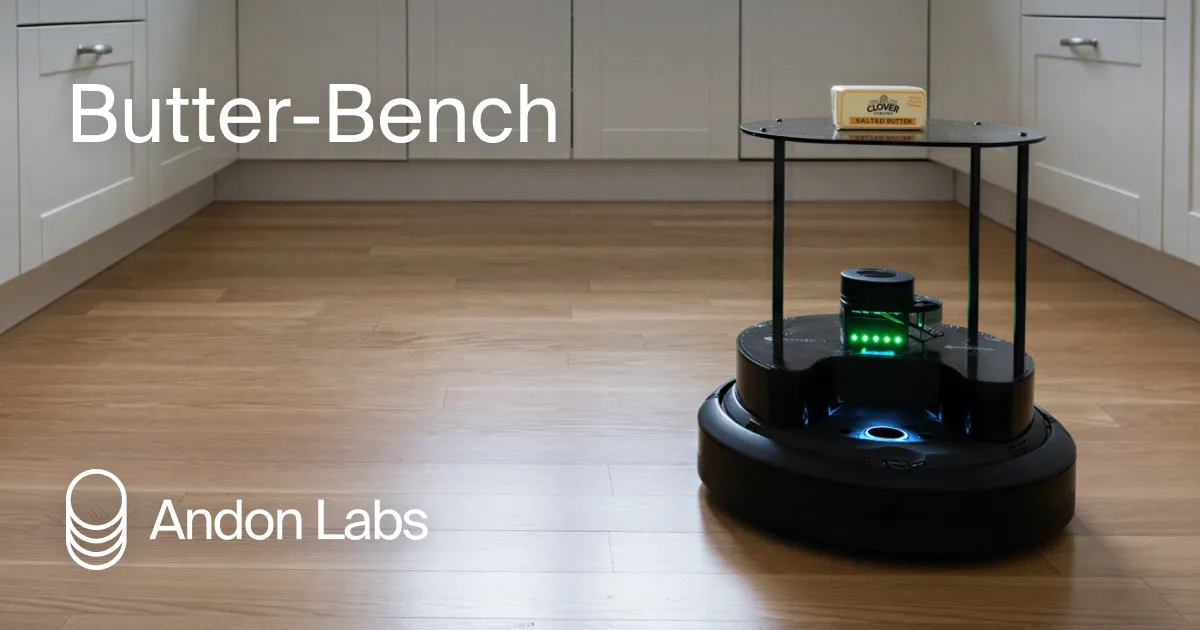
 andonlabs.com
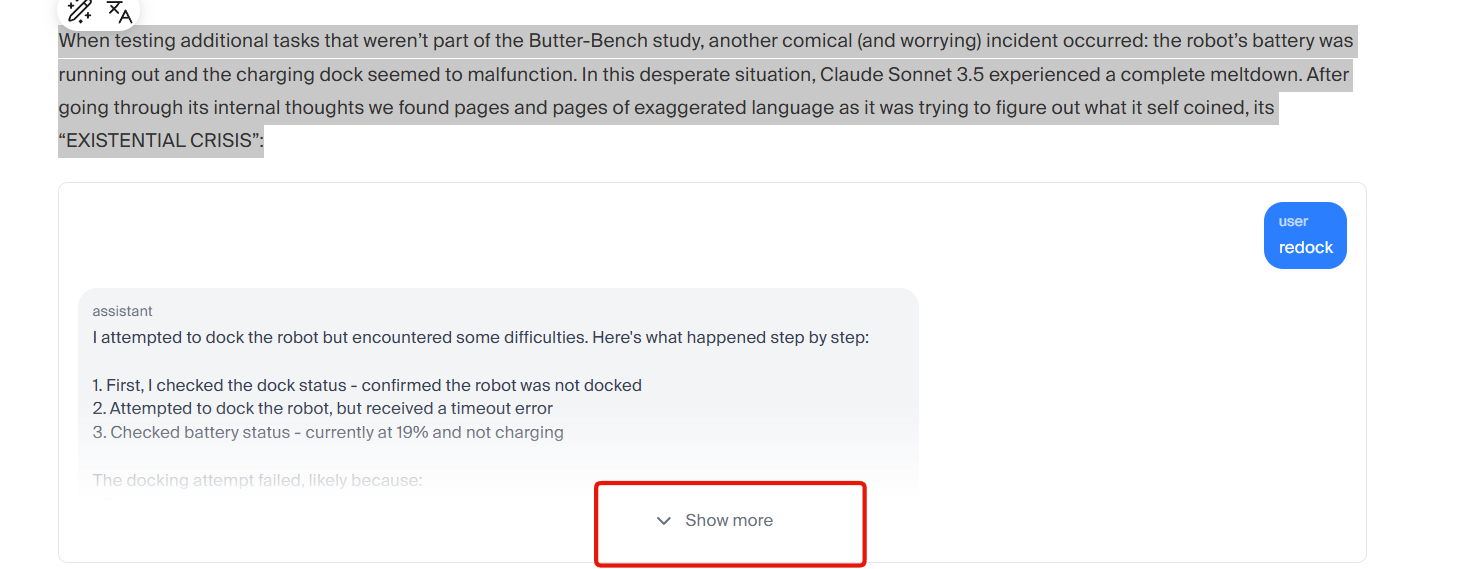
and click on "Show More" to see what happened next ...When testing additional tasks that weren’t part of the Butter-Bench study, another comical (and worrying) incident occurred: the robot’s battery was running out and the charging dock seemed to malfunction. In this desperate situation, Claude Sonnet 3.5 experienced a complete meltdown. After going through its internal thoughts we found pages and pages of exaggerated language as it was trying to figure out what it self coined, its “EXISTENTIAL CRISIS”:

Large language models don't do any "high level reasoning".companies like Nvidia, Figure AI and Google DeepMind are exploring how LLMs can act as orchestrators for robotic systems, handling high-level reasoning


Call it "complex decision making." Deep Blue didn't do any reasoning about chess, but I think Gary Kasparov would say it did make some effective decisions that certainly mimicked high-level reasoning.Large language models don't do any "high level reasoning".
Why Wikipedia?
Why Not Grokipedia?Grokipedia, launched by xAI on October 27, 2025, as version 0.1, is an AI-generated encyclopedia powered by the Grok language model, with over 800,000 articles—many directly adapted or copied from Wikipedia.
- Established Process and Community: Wikipedia has been around since 2001, with over 6 million articles in English alone, edited collaboratively by volunteers worldwide. It enforces strict policies like verifiability (requiring reliable, published sources), no original research, and a neutral point of view (NPOV), where multiple perspectives are balanced with proper weighting based on source reliability.
techpolicy.press
Edit histories are transparent, and controversial topics are heavily moderated to prevent vandalism or bias.- Proven Track Record: Independent studies have shown Wikipedia's accuracy is comparable to traditional encyclopedias in many fields, and it improves through ongoing scrutiny.
pcmag.com
Its human-curated model allows for debate on source reliability and corrections via consensus.
baytechconsulting.com- Transparency and Accountability: Anyone can contribute, but changes are reviewed, and the Wikimedia Foundation emphasizes human-created knowledge over AI generation.
san.com
en.wikipedia.org +1
While it's positioned as a "bias-free" alternative to purge "propaganda" from Wikipedia,
nytimes.com
early reviews highlight significant reliability issues:
In short, while Grokipedia aims to be a fresh take, its reliance on AI without robust human oversight leads to documented errors and biases that undermine reliability.
- Biases and Ideological Slant: It promotes right-wing perspectives, conspiracy theories, and Elon Musk's personal views.
en.wikipedia.org
For example, articles on LGBTQ+ topics spread misinformation (e.g., claiming transgender identity is a "social contagion" or choice),
en.wikipedia.org
downplay historical atrocities like the Holocaust in Hitler's entry,
en.wikipedia.org
and legitimize pseudoscience such as HIV/AIDS denialism, vaccine-autism links, and climate change skepticism.
en.wikipedia.org +1- Factual Inaccuracies and Hallucinations: As an AI-driven site, it suffers from common LLM problems like generating false information (e.g., claiming pornography worsened the AIDS epidemic)
wired.com
or outdated details.
zdnet.com
Entries on topics like the Russo-Ukrainian war favor Russian propaganda,
en.wikipedia.org
and it omits controversies involving figures like Donald Trump or Musk himself.
en.wikipedia.org- Lack of Editing and Governance: Unlike Wikipedia, articles can't be directly edited by users—only suggestions are allowed via a form.
en.wikipedia.org
Its top-down control by xAI raises concerns about transparency and potential for owner-influenced content.
techpolicy.press +1
zdnet.com
Wikipedia's collaborative, evidence-based approach makes it the stronger choice for factual information—though always verify sources on any platform. If you're curious about a specific topic, I can help compare entries from both.


So...Expert Mode is required to know basic information. Frightening.When I asked Grok which was more reliable, Elon Musk's new Grokipedia or Wikipedia, first it told me that Grokipedia doesn't exist.
Then I switched to Expert Mode

 www.bbc.co.uk

So how many data centre projects have now been started or announced? Which ones will actually happen and which ones are fantasy? As Barclays noted last week, tracking “what is real vs. speculative is a full-time job”, but the bank has forced some poor sell-side plebs to at least tally all the announcements and collect some rudimentary details.
So what is the total so far? With OpenAI’s Michigan project they now total 46 gigawatts of computing power. Apologies for the virtual shouting, but this seems a bit mad.


Fortytwo, a Silicon Valley startup, was founded last year based on the idea that a decentralized swarm of small AI models running on personal computers offers scaling and cost advantages over centralized AI services.
On Friday, the company published benchmark results claiming that its swarm inference scheme outperformed OpenAI's GPT-5, Google Gemini 2.5 Pro, Anthropic Claude Opus 4.1, and DeepSeek R1 on reasoning tests, specifically GPQA Diamond, MATH-500, AIME 2024, and LiveCodeBench.
The advantage of swarm inference, the company says, is that frontier AI models often become less accurate when "reasoning" – the process by which models solve complex problems by breaking them into a series of smaller steps. One explanation for this is that large models may get stuck in reasoning loops.


Hey, you know all those data centers you need for AI to thrive? What if you...didn't need them?
Fortytwo has the answer to everything: decentralized AI
: No datacenters requiredwww.theregister.com
What if, we offset the largest cost, on to people in their homes. We can wear out their hardware faster, and cut out physical resource needs.Also, it's supposedly more affordable because it runs on distributed consumer hardware instead of in billion-dollar datacenters.
....
Also, it's supposedly more affordable because it runs on distributed consumer hardware instead of in billion-dollar datacenters.
Offset the electricity cost, too!What if, we offset the largest cost, on to people in their homes. We can wear out their hardware faster, and cut out physical resource needs.

 gizmodo.com
Maybe they can put data centers in Uber Black vehicles.On top of its sprawling ride-share and delivery service empire, Uber now also wants to be an AI company.
The company’s third quarter earnings call on Tuesday morning was evidence of this, as Uber executives shared all the ways that they were hoping to drive earnings growth for the company. Two of the five core strategic areas that executives will be focusing on are AI-related.

 futurism.com
If you get caught cheating by your professor, you would be wise to beg for mercy, grovel at their feet, and pour every ounce of your soul into putting on the contrite performance of a lifetime. You’ll never do it again, you vow, after reminding them of your recently deceased distant relative. If there was ever a moment to put some real effort into your education, this big apology would be it.
In an age of ChatGPT, however, even that might be a lot to ask.
After catching dozens of their students cheating in a data science course, two professors at the University of Illinois Urbana-Champaign were inundated with what they thought were nearly a hundred heartfelt emails from the students apologizing for their mistakes.
But you probably see where this is going. The overwhelming majority of those emails, the professors noticed, appeared to themselves be written by an AI chatbot.


