I'm not surprised that the Taliban took Afghanistan back so easily and that the US-backed Afghan government collapsed within a few days. Let's face it, the whole image of a Western-style democratic government (which, as it turns out, could only stand as long as the American soldiers were there) was smoke and mirrors. Of course the US were defeated (so it's finally time to point those chevrons down). The US Armed Forces spent twenty years and bazillions of USD, yet failed to weaken and eradicate the jihadists.
But how did the US come to this inglorious defeat? What's behind the decision to leave so quickly? How did the Taliban manage to survive, regroup, and retake Afghanistan in what looked like a cakewalk, with the country's official army and government surrendering unconditionally? Let's talk
facts. It was no surprise - unless you were a "political analyst" in a "prestigious" mainstream publication. As long as US troops were in Afghanistan, the Taliban had no chance of securing a military victory. But, being a guerrilla force, winning battles is less important than not being defeated, neutralised, and eradicated as a
movement. The Taliban succeeded in this. They could never defeat the Americans, but the Americans couldn't completely eradicate them. This meant certain territories were kept under Taliban rule and served as bases for their operations.
So, after the Americans left, there was
nothing to hold back the Taliban. In the West, governments, embedded "journalists", "esteemed" establishment academics, and "political scientists" had all conspired to create a Potemkin village: they were reassuring everyone that a new state had been put in place, with a well-trained and equipped 300,000-strong army, etc. I'll say it again: it was a Potemkin village; nothing more, nothing less. Yes, the army had all the trappings of an army, weapons, uniforms, precision drills, that sort of crap, but it had no morale, and it had no loyalty to the government. So, it fell apart at the mere sight of the Taliban.
Also, the elite that was running the country had no connection to the majority of the population. Furthermore, the US had made alliances with various tribal leaders, landowners, and warlords who were also running drugs (opium production). This doesn't mean these guys had any relationship with the population. On the other hand, the Taliban, despite not expressing the majority of the Afghan people, are deeply connected with the Pashtuns and have strong roots in certain areas and parts of the populace.
So, on one hand we have a government and a state constructed solely with the support of the US military presence and, on the other hand, a popular movement which, despite its obvious barbarity and extremism, has roots in local societies and managed to survive for twenty years. This helped it gain support abroad, especially with various Persian Gulf monarchies of similar ideology (Qatar, Saudi Arabia) and rebuild its cooperation with Pakistan.
Pakistan turned a blind eye to the Taliban having hiding places in its lands. Whenever the Taliban were coming under serious pressure from American attacks, they crossed the border and fell back in Pakistan, where they had safe bases from where they could launch new offensives in Afghanistan. Had Pakistan closed its borders to the Taliban, attacking their leaders and trapping the rest of them in Afghanistan and leaving them at the mercy of the US Armed Forces, I'm sure we'd be reading a different story. But that's not what happened.
Now, as to US withdrawal, it was the obvious choice after having been defeated. Only through constant, costly military presence could the US ensure the longevity of the regime it had installed in Afghanistan - mind you, this regime didn't even control the entire country: it couldn't protect both Kabul and Kandahar. It couldn't
function without the US propping it up, and the US realised this couldn't last forever. The top brass in the US decided there was no reason for them to hang around in Afghanistan forever: Al-Qaeda was no more, and the creation of a new group like it seemed implausible, as the jihadist movement had taken on other forms, especially after ISIS.
Of course, the US still suffered a defeat: they couldn't destroy the Taliban, or create what they were saying they wanted to,
i.e. a new, modern, democratic, Afghan state. This never happened. As was the case with every other attempt to "export democracy" (a basic element of US strategy from the days of Clinton and all the way to yesterday), this one failed too. So, they had two choices: One, stay there forever. Two, find a way to make a deal with the Taliban and move out. Trump had made this deal with the Taliban, although many forget it nowadays. And Biden simply follows in Trump's footsteps.
As for the chaos we saw at the Kabul Airport, with thousands of Afghans trying to flee, the blame lies
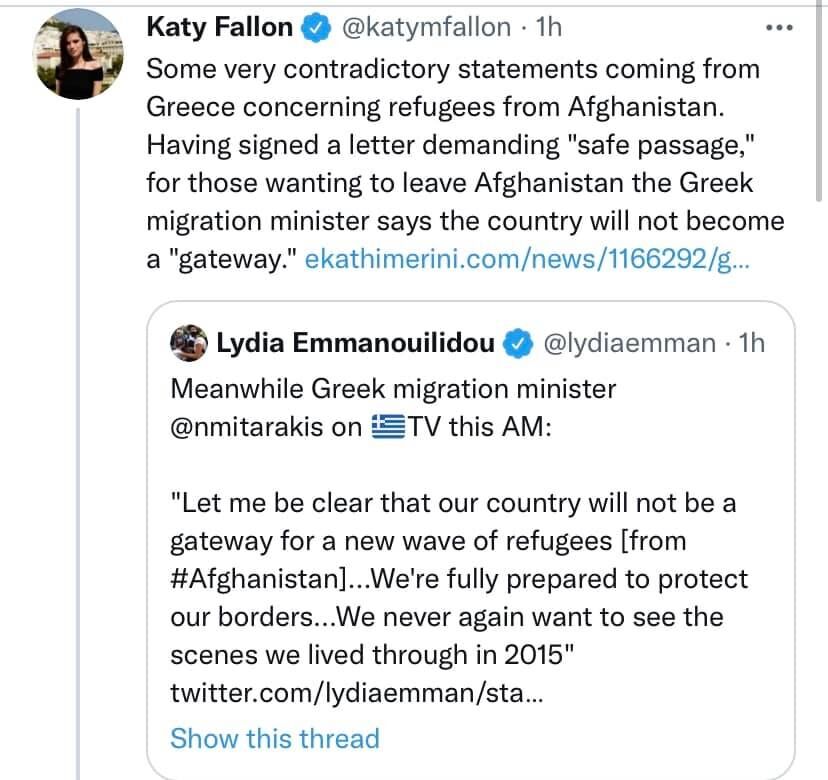
squarely with the US and its allies (the EU and NATO in general). Thousands of Afghans, either to make ends meet or because they believed in a westernisation of Afghanistan, worked with the allied forces. They were assured that, if things went wrong, they'd be given visas and granted safe passage to the West. We're talking about 200-300 thousand people. Of course, given that there's over sixty countries these people worked with, each country wouldn't need to take an exorbitant number of people. The US, for instance, could very easily issue visas for 50,000 people. As for Greece's alt-right government... Here's what Notis Mitarakis, its Immigration Minister, has to say:
Of course, Afghans who worked with the NATO and EU countries have every reason to fear for their lives. It's not just the barbaric Taliban administration; they fear retaliation stemming from being viewed as collaborationists. If NATO and EU countries don't honour the promises they made, the blood of these people is on their hands.
As for Ashraf Ghani, he's a coward. He should stand up for his government and try to do something for his citizens, not load a few vehicles with cash and flee before the Taliban even got to Kabul's suburbs. Salvador Allende (toppled by the US-backed Pinochet junta so Milton Friedman could get a country to use as his lab rat) resisted and made his final stand. Then again, could we ever expect this corruption-riddled and disconnected from Afghan reality elite to show even a vestige of spine? No.
Will the Taliban's victory embolden other jihadist groups? Absolutely. It'll boost their prestige and appeal. Of course, this'll also depend on the Taliban administration's success, whatever this success may be. I'm certain the Saudi head-chopping dynasty will aid them, and I'm certain Turkey's Erdogan regime will do the same.