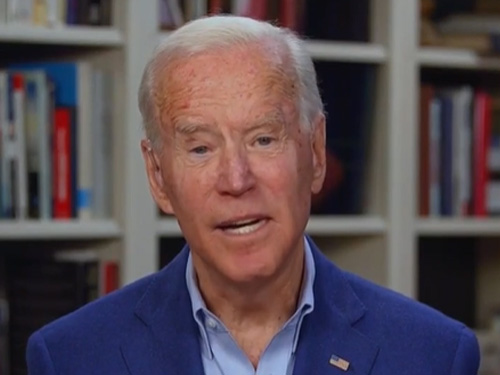
He was asked
and he replied
In an interview Monday with MSNBC's Yasmin Vossoughian, former VP Joe Biden explained why the events of the coronavirus pandemic so far have not made him reconsider his position opposing single-payer health care. MSNBC, YASMIN VOSSOUGHIAN: I do have one final question for you, because as you've...

www.realclearpolitics.com
He then went on to discuss reassembling the Pandemic Response Unit set up by Obama and himself and disbanded by Trump.
I think that's a fair point -- that the public health crisis caused by the pandemic has revealed, and will continue to reveal, glaring inadequacies in US health care provision quite apart from the question of who pays for patient care at the point of delivery, and that whoever wins in November needs to address those inadequacies and gaps in the light of the situation then.
Obviously, "how will I pay for it?" is a huge concern for both people in such very different places as both NYC and rural Louisiana who fear they will need treatment for the virus, but there's also the even greater concern of "regardless of whether I can pay for it or not, will there be sufficient hospital beds, ventilators and medical staff available locally to provide it?"
On its own, having a single payer health service doesn't solve the problem of providing and funding a system that is capable of providing high-quality health care to everyone who needs it, whatever their medical needs.
We've had one in the UK for the last 70 years, and we know that all too well -- if the taxpayer, through the government, is paying for the service, then the government has to concern itself with questions about building new hospitals, providing drugs and equipment for both new and existing therapies, ensuring adequate staffing levels and so on, along with providing community medical care by ensuring everyone has access to a local medical practice where they are registered with their own doctor (or team of doctors) whom they can see at short notice.
Additionally, all that, of course, will have to be considered in the context of all the other demands on government spending (unemployment, education, defence and so on), at a time the world economy will be completely trashed.
Having a state funded National Health Service like ours in the UK is a wonderful thing, and it's one of the main reasons I consider myself so fortunate to have been born in the UK and not the US.
However, having a state funded NHS doesn't, on its own, solve all the problems of health care provision -- it's a far better way of doing it than what you have in the US, but it's not sufficient -- and who pays for treatment at the point of delivery is only part of the overall problem of what the service should be like and how it should be managed and funded.
Someone has to decide, after all, how many operating theatres a hospital should have, and how they should be equipped and for what sort of specialisms they should be equipped, and do to that on a regional and national basis, and not just a local one.
Running such an undertaking is hugely complex -- the NHS is, or was at one point, the largest employer in Europe -- and it's something that can't be allowed to go wrong.
Furthermore, as with any undertaking of that size, effecting radical change is a massive task which demands huge amounts of time and money, particularly since you have to start your journey to where you want to be from the position in which you are at the moment, even though that's not, in an ideal world, where you'd want to start, and each part of the route involves careful planning and coordination.
It's so much bigger than simply "single payer or not" and I don't think many people in the US, not even Bernie Sanders, realise quite what replacing the US's profoundly flawed system of medical provision will mean.
Here's a specific question -- it's 2024, and I need an abortion. I live somewhere like Alabama or Georgia.
OK, because of President Sanders' reforms I won't have to worry about how I pay for it, but how do these reforms ensure I can readily obtain one locally, particularly if my local hospital is a religious foundation with theological objections to providing such treatment?