They just get worse and worse

WolfEyes

Well known member no one knows
Joined
Sep 20, 2018
Messages
4,502
SL Rez
2004
Joined SLU
2009
Because I view religion (at least in this context) as a social practice -- something that groups of people do, and something which they and others see as important to their social identity, rather than what they may, as individuals, believe -- I tend to ask why particular groups occupy the positions in particular power structures that they do.

That's certainly the only way to understand European colonial history -- missionaries operated because they were allowed to, as agents of the colonial power -- and I regard the US as primarily a land empire, like those of Russia or Austria-Hungary.

Similarly, in the US, I would suggest that white conservative evangelical protestants have become the political constituency that they are because, since the 1970s and 80s, the US Republicans and their financial backers have have spent a great deal of time and money cultivating and radicalizing them and turning them into an organised voting block, as part of the "southern strategy."

US politics, or so it seems to me, have always been very clearly about who is allowed to own land and property, and how they're able to exploit it, rather than anyone's religious views.
I wasn't asking you why, I was asking you what. What is it you are questioning?
 
  • 1Thanks
Reactions: Innula Zenovka

Innula Zenovka

Nasty Brit
VVO Supporter 🍦🎈👾❤
Joined
Sep 20, 2018
Messages
24,119
SLU Posts
18459
I wasn't asking you why, I was asking you what. What is it you are questioning?
I am questioning the influence that religion has played, as force in its own right, on the development of the US, and particularly the influence of the extreme Calvinists who formed the Plymouth Settlement on the course of US history and economic development.

As I understand it, there have been a series of evangelical "Great Awakenings" from the 1730s onwards, and while certainly they've been very influential in the history of particular communities and areas in particular times and places, I'm struggling to see organised religion and confessional politics playing the sort of role they've done in Europe, Asia and Africa over the centuries.
 

WolfEyes

Well known member no one knows
Joined
Sep 20, 2018
Messages
4,502
SL Rez
2004
Joined SLU
2009
I am questioning the influence that religion has played, as force in its own right, on the development of the US, and particularly the influence of the extreme Calvinists who formed the Plymouth Settlement on the course of US history and economic development.

As I understand it, there have been a series of evangelical "Great Awakenings" from the 1730s onwards, and while certainly they've been very influential in the history of particular communities and areas in particular times and places, I'm struggling to see organised religion and confessional politics playing the sort of role they've done in Europe, Asia and Africa over the centuries.
What sort of role are you saying they have done in Eurasia and Africa over the centuries that they haven't at least tried in the US at some point?
 

danielravennest

Well-known member
Joined
Sep 21, 2018
Messages
3,708
SLU Posts
9073
As I understand it, there have been a series of evangelical "Great Awakenings" from the 1730s onwards, and while certainly they've been very influential in the history of particular communities and areas in particular times and places, I'm struggling to see organised religion and confessional politics playing the sort of role they've done in Europe, Asia and Africa over the centuries.
I see religion as having been strong in particular regions of the US. For example we have an area described as the "Bible Belt". But it wasn't a single monolithic faith the way Catholicism was in Spain, because the US was colonized by different people in different parts, and then they proceeded to move around and mix. Growing up in New York City I saw this first-hand. There are numerous neighborhoods that were occupied by successive waves of immigrants, who gathered together with others that shared a home country or religious group. But over time these "ethnic neighborhoods" would get diluted by other people moving in. In more recent decades, religion as a whole is fading in importance.
 
  • 1Thanks
Reactions: Innula Zenovka

Dakota Tebaldi

Well-known member
VVO Supporter 🍦🎈👾❤
Joined
Sep 19, 2018
Messages
9,892
Location
Ohio
Joined SLU
02-22-2008
SLU Posts
16791
In other news, Anchorage's first black city police chief just unexpectedly resigned after only a few months on the job, and has refused to give any statement about why. But sources are suggesting that it's over improper demands made by Anchorage's present mayor, apparently a full-bore conspiracy-loon who allegedly (among other things) on one occasion during a tour of the city's water department just started manually shutting off the flouridation equipment, and on another occasion attempted to order the police chief to have the department raid a city hospital and force healthcare providers to give Ivermectin to a COVID patient and arrest any doctors, nurses, or other staff who refused or interfered, a request that the (now former) police chief refused.

The same source alleges that a "faction" of city police officers, who happen to all attend the same church as the mayor, have begun basically taking orders from him directly rather than department leadership.

The chief's resignation has been widely reported but right now only this one source is making the allegations about the mayor being a lunatic; so we'll have to see where this ends up going. The claims could be unsubstantiated.
 

Innula Zenovka

Nasty Brit
VVO Supporter 🍦🎈👾❤
Joined
Sep 20, 2018
Messages
24,119
SLU Posts
18459
What sort of role are you saying they have done in Eurasia and Africa over the centuries that they haven't at least tried in the US at some point?
Who are "they" in this context? Confessional politics, whether Catholic v Protestant, or Catholic v Orthodox, or Shia v Sunni, or Hindu v Muslim, or Christian v Muslim, or monotheist v polytheist have played a very large role in European, Asian and African history, in their different ways, with conversion often offering a route to social and political advancement,
What sort of role are you saying they have done in Eurasia and Africa over the centuries that they haven't at least tried in the US at some point?
I'm not talking about what's been tried. What I'm saying is that the US has never had an established church, or been part of a caliphate, or imposed civil disabilities on members of particular faith groups, or charged them higher taxes or whatever -- that's been an important part of many countries' history, but not that of the US.
 

WolfEyes

Well known member no one knows
Joined
Sep 20, 2018
Messages
4,502
SL Rez
2004
Joined SLU
2009
Who are "they" in this context? Confessional politics, whether Catholic v Protestant, or Catholic v Orthodox, or Shia v Sunni, or Hindu v Muslim, or Christian v Muslim, or monotheist v polytheist have played a very large role in European, Asian and African history, in their different ways, with conversion often offering a route to social and political advancement,

I'm not talking about what's been tried. What I'm saying is that the US has never had an established church, or been part of a caliphate, or imposed civil disabilities on members of particular faith groups, or charged them higher taxes or whatever -- that's been an important part of many countries' history, but not that of the US.
They = organized religions

No, the US has never had an "official" church and better never have one. That has nothing to do with what I am saying.

Wait, are you saying the Catholic church never established residential schools in the US, that other religions didn't dispossess us of our land, languages, cultures? That the US government didn't tax the fuck out of us and didn't shove us onto the poorest of soils for farming and then force us to farm with no tools and no knowledge. I could go on and on and on and on.

Yeah, I guess you are right. First Nations history is not important in the US. Anyone who isn't white and male in the US isn't important. In fact, they want the rest of us gone.

Five hundred years of history is completely worthless because the people it deals with are not white.

Yeah, I'm pissed but not at you. I can't help but get angry every time I have to think about this.

And I'm probably completely misunderstanding what you are trying to understand. It goes back to that knee jerk reaction I was talking about, the "get the fuck off my planet" one.

All because religions* want to control everyone and everything.


*The people not the organization itself.
 

Innula Zenovka

Nasty Brit
VVO Supporter 🍦🎈👾❤
Joined
Sep 20, 2018
Messages
24,119
SLU Posts
18459
They = organized religions

No, the US has never had an "official" church and better never have one. That has nothing to do with what I am saying.

Wait, are you saying the Catholic church never established residential schools in the US, that other religions didn't dispossess us of our land, languages, cultures? That the US government didn't tax the fuck out of us and didn't shove us onto the poorest of soils for farming and then force us to farm with no tools and no knowledge. I could go on and on and on and on.

Yeah, I guess you are right. First Nations history is not important in the US. Anyone who isn't white and male in the US isn't important. In fact, they want the rest of us gone.

Five hundred years of history is completely worthless because the people it deals with are not white.

Yeah, I'm pissed but not at you. I can't help but get angry every time I have to think about this.

And I'm probably completely misunderstanding what you are trying to understand. It goes back to that knee jerk reaction I was talking about, the "get the fuck off my planet" one.

All because religions* want to control everyone and everything.


*The people not the organization itself.
I think you do misunderstand me, I'm afraid, probably because I'm not making myself clear enough.

What I'm trying to say that the Catholic Church didn't do that in Europe and Eurasia, and neither did the Muslim empires, because organised religion played a very different historical role in the late Roman, and later still, the Frankish, empires, and also in the expansion and administration of various Muslim empires, from the role it played around a thousand years later in the colonization of the USA (a product of early capitalism and the Enlightenment).

Back in the first millennium CE and first two or three hundred years after, conversion was, at least initially, a matter of diplomacy involving the elites, as was the transfer of land ownership, if that actually happened. For the common people, things carried on pretty much same, except they had to pay their taxes to someone different.
 

WolfEyes

Well known member no one knows
Joined
Sep 20, 2018
Messages
4,502
SL Rez
2004
Joined SLU
2009
I think you do misunderstand me, I'm afraid, probably because I'm not making myself clear enough.

What I'm trying to say that the Catholic Church didn't do that in Europe and Eurasia, and neither did the Muslim empires, because organised religion played a very different historical role in the late Roman, and later still, the Frankish, empires, and also in the expansion and administration of various Muslim empires, from the role it played around a thousand years later in the colonization of the USA (a product of early capitalism and the Enlightenment).

Back in the first millennium CE and first two or three hundred years after, conversion was, at least initially, a matter of diplomacy involving the elites, as was the transfer of land ownership, if that actually happened. For the common people, things carried on pretty much same, except they had to pay their taxes to someone different.
Ok, yeah, no they didn't do that in Europe or anywhere else in the world for that matter. So why just the US (and Canada)? I include Canada because the same things happened there that happened in the US.

Of all the conquerors, Alexander is the only one who came close to getting it right.

"Alexander would take away the political autonomy of those he conquered but not their culture or way of life. In this way, he would gain their loyalty by honoring their culture, even after the conquest was complete, creating security and stability.

Organized religions have done the exact opposite in the US.


ETA: Thought you might be interested in reading this: Religion and Native American Assimilation, Resistance, and Survival
 
Last edited:

Veritable Quandry

Specializing in derails and train wrecks.
Joined
Sep 19, 2018
Messages
5,368
Location
Columbus, OH
SL Rez
2010
Joined SLU
20something
SLU Posts
42
I am questioning the influence that religion has played, as force in its own right, on the development of the US, and particularly the influence of the extreme Calvinists who formed the Plymouth Settlement on the course of US history and economic development.

As I understand it, there have been a series of evangelical "Great Awakenings" from the 1730s onwards, and while certainly they've been very influential in the history of particular communities and areas in particular times and places, I'm struggling to see organised religion and confessional politics playing the sort of role they've done in Europe, Asia and Africa over the centuries.
Those Awakenings did have a profound influence on American thought particularly in our most destructive beliefs. They gave American politics and culture a foundation in the idea of predestination and the Elect of God. In short, the idea that poisons much of our discourse is that God favors the "good" with health and material wealth and punishes the "wicked" with poverty and affliction.

There is a strong current in our politics of blaming the poor and sick for their conditions, and seeing problems as evidence of unworthiness instead of socially rooted problems to solve. Along with seeing addiction and other conditions as a moral failing, not a health condition. Or failing to see how poverty leads to crime, sickness, and other negative outcomes. This is why we have the highest incarceration rate in the developed world and no social safety net or healthcare system. This is why many Americans, even those who are poor, oppose progressive taxation for social spending. This is why a pandemic is an issue of personal liberty instead of communal responsibility. Because of a vain belief that God will protect his chosen from their own stupidity.
 

Innula Zenovka

Nasty Brit
VVO Supporter 🍦🎈👾❤
Joined
Sep 20, 2018
Messages
24,119
SLU Posts
18459
Those Awakenings did have a profound influence on American thought particularly in our most destructive beliefs. They gave American politics and culture a foundation in the idea of predestination and the Elect of God. In short, the idea that poisons much of our discourse is that God favors the "good" with health and material wealth and punishes the "wicked" with poverty and affliction.

There is a strong current in our politics of blaming the poor and sick for their conditions, and seeing problems as evidence of unworthiness instead of socially rooted problems to solve. Along with seeing addiction and other conditions as a moral failing, not a health condition. Or failing to see how poverty leads to crime, sickness, and other negative outcomes. This is why we have the highest incarceration rate in the developed world and no social safety net or healthcare system. This is why many Americans, even those who are poor, oppose progressive taxation for social spending. This is why a pandemic is an issue of personal liberty instead of communal responsibility. Because of a vain belief that God will protect his chosen from their own stupidity.
Yes, but I guess I'm still sufficiently influenced by Marxism to see things in terms, for want of a better word, of the economic base and the ideological superstructure, crude though those concepts obviously are*.

That is, when you have a colonial enterprise, financed by capitalists, and the main business model involves expropriating native people's land and enslaving them to work it, and kidnapping people from West Africa and forcing them and their descendants to work in forced agricultural labour camps, or later as leaseable convict labour, the schools, churches and missions -- at least those financed by the people benefiting from this system -- are going to promote doctrines that justify this state of affairs.

I dunno -- you're the historian, not me, and it's your country, not mine, but it looks to me more like the ideology being a consequence of the structures of power and dominance rather than a cause.

*(vulgar Marxism: Communists running round shouting "knickers!")
 

Govi

Crazy woman yells at clouds
VVO Supporter 🍦🎈👾❤
Joined
Sep 20, 2018
Messages
1,586
Location
North of Surf City
SL Rez
2004
Joined SLU
27.05.2009
SLU Posts
5294
  • 1Thanks
Reactions: Innula Zenovka

Veritable Quandry

Specializing in derails and train wrecks.
Joined
Sep 19, 2018
Messages
5,368
Location
Columbus, OH
SL Rez
2010
Joined SLU
20something
SLU Posts
42
Yes, but I guess I'm still sufficiently influenced by Marxism to see things in terms, for want of a better word, of the economic base and the ideological superstructure, crude though those concepts obviously are*.

That is, when you have a colonial enterprise, financed by capitalists, and the main business model involves expropriating native people's land and enslaving them to work it, and kidnapping people from West Africa and forcing them and their descendants to work in forced agricultural labour camps, or later as leaseable convict labour, the schools, churches and missions -- at least those financed by the people benefiting from this system -- are going to promote doctrines that justify this state of affairs.

I dunno -- you're the historian, not me, and it's your country, not mine, but it looks to me more like the ideology being a consequence of the structures of power and dominance rather than a cause.

*(vulgar Marxism: Communists running round shouting "knickers!")
I would say there is a feedback loop. The ideological structure is created to justify the economic basis, but then later decisions that impact the economic basis are made using the ideological framework as the situation changes.

Looking at Stewart Brand's pace layer model of complex systems:

In Europe, Puritan influence never extended deeper that a Fashion. It came and went without penetrating into the deeper, more lasting layers of culture. In America, the Awakenings spread assumptions of predestination deeper into more lasting layers to where it is now a part of our governance and culture, at least for a sizable chunk of the population. At that time, the economic structure was not that different than in England (aside from the fact that England restricted a great deal of economic activity in the colonies, but we ignored those laws so it doesn't count) but it took root here while in most of Europe it did not. Most can't point to the specific doctrines and events that baked these assumptions into American culture because it is now a diffuse part of our culture. But it helps to explain why Americans are less inclined to charity or collective action than the European cultures that many of our immigrants came from, and more inclined to moral judgment and rough individualism. There are other strands that lead there as well, especially the Frontier myth, but there is a strand that can be traced to the role Puritan theologians had in the colonies.
 

Innula Zenovka

Nasty Brit
VVO Supporter 🍦🎈👾❤
Joined
Sep 20, 2018
Messages
24,119
SLU Posts
18459
At that time, the economic structure was not that different than in England
I don't understand. When did a sizable proportion of English agriculture depend on slave labour, and when was land in England free for the taking (other than by the enclosure of common land) by forcing the local population out at gunpoint?
 

Veritable Quandry

Specializing in derails and train wrecks.
Joined
Sep 19, 2018
Messages
5,368
Location
Columbus, OH
SL Rez
2010
Joined SLU
20something
SLU Posts
42
I should say not within England, but the Empire as a whole. North America was a tiny cog in a global machine headquartered in the UK.

eta: It would be hard to describe the New England colonies in those terms as well. While land was "free" it was occupied in ways that took centuries for Americans to pry away from its owners, and slavery was not the primary agricultural method above the Tobacco belt.
 

WolfEyes

Well known member no one knows
Joined
Sep 20, 2018
Messages
4,502
SL Rez
2004
Joined SLU
2009
I don't understand. When did a sizable proportion of English agriculture depend on slave labour, and when was land in England free for the taking (other than by the enclosure of common land) by forcing the local population out at gunpoint?
I'm not disagreeing with you, I'm curious. Could not indentured servitude be considered a form of slavery and did not England have a form [of] indentured servitude, perhaps in the way they sent debtors to prison and then on to places like Australia? Slaves were housed, clothed and fed but not given wages. Same applied to indentured servants. Since the labor of the servant was the "product" bought and sold they weren't considered slaves. To me, that's nothing more than plausible deniability. A means of justifying a form of slavery by making it appear to be something different on the surface.

Or maybe I'm blending indentured servitude with the serfs and peasants. I really don't see a whole lot of difference in the way servants/serfs/etc. in England were treated and the whole indentured servant (to pay for immigration to the US) and slavery thing. They were all fed, clothed and housed, some were paid, some weren't. Was the payment worth the abuse? What choice did they have?

Land has never been just "free for the taking" but that hasn't stopped people from doing just that. It still happens to this day. It doesn't really get better.

Ok, enough of my bullshit. I'm gonna go finish building my Firefly. Just wish they hadn't made the docking pads hover vessels only so I could build the shuttles as small vessels and dock them on the sides of the ship. Oh well. At least I managed to build a Mule as a hover vessel and there should still be plenty of room in the cargo bay for a small SV. Smaller than I wanted probably but it'll do, pig.

Shut up, Wolfie. :beatup:

ok. 🤫
 
  • 1Thanks
Reactions: Innula Zenovka

Innula Zenovka

Nasty Brit
VVO Supporter 🍦🎈👾❤
Joined
Sep 20, 2018
Messages
24,119
SLU Posts
18459
I should say not within England, but the Empire as a whole. North America was a tiny cog in a global machine headquartered in the UK.
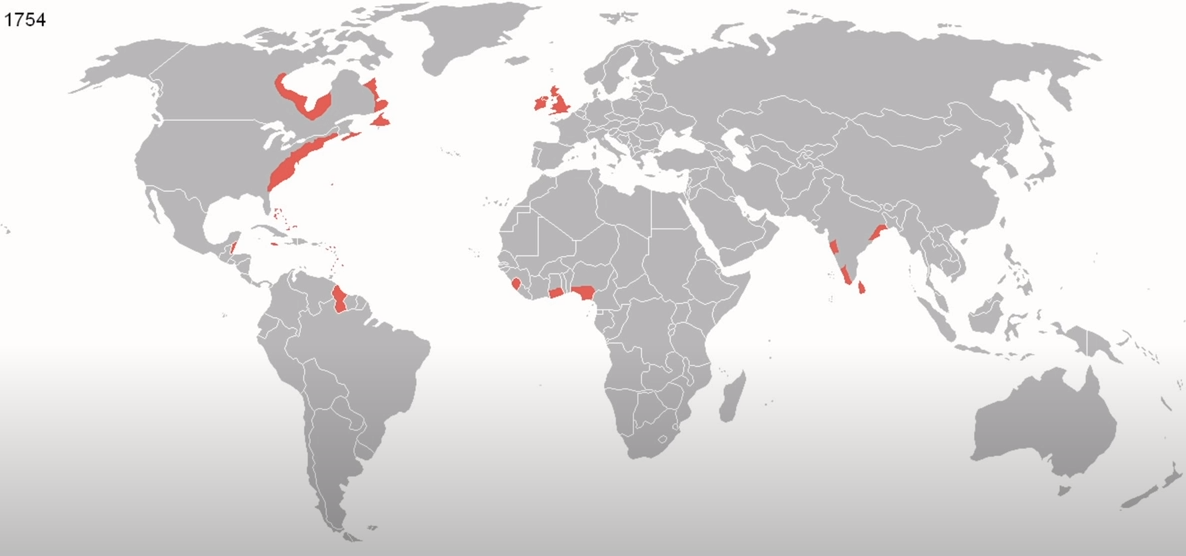
I don't know about a tiny cog -- this is a map of the British Empire in 1754, in which the American and Caribbean colonies were an integral part of the "triangle trade" -- manufactured goods shipped to West Africa to be bartered for slaves, who were sold in the Americas and the West Indies to raise cash crops (sugar, coffee, rice, etc) for export either to New England or back to England for processing and sale.


(screenshot from this video).

I'm not disagreeing with you, I'm curious. Could not indentured servitude be considered a form of slavery and did not England have a form [of] indentured servitude, perhaps in the way they sent debtors to prison and then on to places like Australia? Slaves were housed, clothed and fed but not given wages. Same applied to indentured servants. Since the labor of the servant was the "product" bought and sold they weren't considered slaves. To me, that's nothing more than plausible deniability. A means of justifying a form of slavery by making it appear to be something different on the surface.

Or maybe I'm blending indentured servitude with the serfs and peasants. I really don't see a whole lot of difference in the way servants/serfs/etc. in England were treated and the whole indentured servant (to pay for immigration to the US) and slavery thing. They were all fed, clothed and housed, some were paid, some weren't. Was the payment worth the abuse? What choice did they have?
Serfdom in England was just about over in 1500 and formally came to an end in 1574, when Elizabeth freed the last remaining serfs. Indentured servitude was, like transportation to the Antipodes later, a punishment for minor offences that weren't considered serious enough for the death penalty -- essentially, it was a way of getting rid of the urban poor, of whom there were a great number.

I would argue that indentured servitude was very different from slavery, in that while the conditions for the servants were, or could be, and particularly if they were sent to the West Indies or Guyana, almost -- but not quite -- as harsh as for African slaves, indentured servants enjoyed a small measure of legal protection and, crucially, their condition was temporary, not permanent, and was not heritable. So at the end of the indenture (typically 7 years) the servant was free to seek work as a waged labourer, and could return to England if they could manage to secure passage. And, most importantly, their children did not inherit their status as slaves.
 
Last edited:
  • 1Thanks
Reactions: Veritable Quandry

Dakota Tebaldi

Well-known member
VVO Supporter 🍦🎈👾❤
Joined
Sep 19, 2018
Messages
9,892
Location
Ohio
Joined SLU
02-22-2008
SLU Posts
16791
Ok, yeah, no they didn't do that in Europe or anywhere else in the world for that matter. So why just the US (and Canada)? I include Canada because the same things happened there that happened in the US.
Because the First Nations weren't economically exploitable - not on the large-scale.

What I mean is - when Great Britain took over, say.....India or Palestine. India had money, before the British got there. Palestine, had money. Indonesia had money. These nations already had industry and mass-agriculture. Much like Alexander (as you mentioned), the British could install a small administrative body to run those countries and accept the money, but largely leave the people to continue as before using those countries' own already-existing infrastructure....so they could continue to produce those goods and the money, which of course the British could then take.

Native Americans, at least the ones on the eastern seaboard first encountered by the British - they didn't have money, or an industrial or agricultural product that was relevant to British interests. They DID farm - they produced lots of corn and tobacco, but at the time of contact these crops were unknown in the rest of the world and there wasn't a market for them yet. There was the idea of slaving, and the Spanish certainly gave that a shot in the Americas; but while the British colonists dabbled a bit, it turned out that on the large they didn't really have the stomach for the "work" of it, preferring mostly to just buy slaves from the Dutch who were already doing that "work" in Africa.

What I'm trying to say is, although I hate even putting it this way, but unlike the indigenous peoples of other colonized lands the Native Americans as a population weren't "useful" to the colonial powers. The land itself was far more valuable to them, so the indigenous nations were an inconvenience that needed to be pushed out of the way so they could put Europeans on it who would "properly" develop it to its full potential.

Sadly it wasn't just North America that this happened in, either. The indigenous people of Australia also didn't have anything to offer the colonial powers, and were pushed out of their lands in the same kind of way.
 
  • 1* Popcorn *
Reactions: Govi

Veritable Quandry

Specializing in derails and train wrecks.
Joined
Sep 19, 2018
Messages
5,368
Location
Columbus, OH
SL Rez
2010
Joined SLU
20something
SLU Posts
42
I don't know about a tiny cog -- this is a map of the British Empire in 1754, in which the American and Caribbean colonies were an integral part of the "triangle trade" -- manufactured goods shipped to West Africa to be bartered for slaves, who were sold in the Americas and the West Indies to raise cash crops (sugar, coffee, rice, etc) for export either to New England or back to England for processing and sale.
It's a fair point. I just looked at population numbers, and didn't realize that the colonies were almost 20% of the population of the Empire at the time. And in New England, the coastal cities were most definitely involved in the triangle trade, and starting illegally to cut out England by making rum and whiskey that could be taken straight to Africa for barter to acquire slaves. That's the first real conflict between the colonies and the Crown, as it was avoiding paying revenue necessary to defend the colonies and shipping (and enrich traders based in England). The Southern colonies had a very different economy, and participated in the Triangle Trade as importers of slaves and exporters of agricultural goods, primarily tobacco, rice, and indigo.

In New England, that idea of predestination certainly made it easier to buy and sell people into slavery, as they were clearly not part of God's Elect. And the congregations in Boston certainly did a bit of bait-and-switch by pretending to be akin to the farmers a few miles inland instead of the urban population of the other parts of the Empire where they had more economic interests in common. Pretending to be an agrarian nation when you are in fact an international economic center is something fairly common that fit in with the narrative that eventually put the Puritans and other small farmers at the center of our national myths.
 
  • 1Thanks
Reactions: Innula Zenovka