- Joined
- Sep 19, 2018
- Messages
- 9,798
- Location
- Ohio

- Joined SLU
- 02-22-2008
- SLU Posts
- 16791


"now picture the other [thousands of] players who were trying the game, and probably will never come back, because the game is unplayable.”Ubisoft's NFT game, called "Champions Tactics: Grimoria Chronicles", has been exploited by one particular player who has somehow been auto-winning matches, with over 56,000 wins to his name so far.



 futurism.com
The slick betting was the insurance companies canceling everyone’s home insurance four months ago.Oh wow, sicko gambling going on in Cryptoland. How...expected.
Crypto Platforms Like Polymarket Now Taking Bets on Los Angeles Fire Devastation
Users on the prediction market Polymarket are gleefully betting on the devastation caused by the Los Angeles Palisades wildfire.
 futurism.com
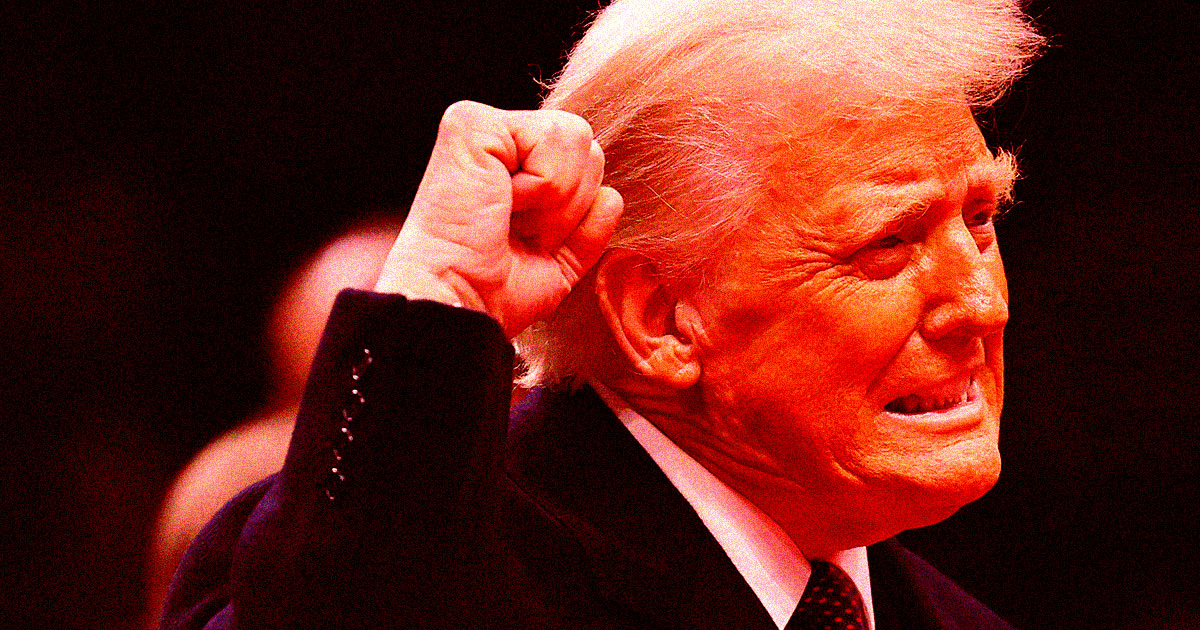
President Donald Trump launched a memecoin days before being inaugurated, earning him more money in 24 hours than he had in the previous 78 years of his life.
Trump's wife Melania also got in on the fun with her own crypto launch, uninspiringly dubbed "Melania," on Sunday — the launch of which, dramatically, seems to have caused her husband's memecoin to crash.
Put simply, this is the president of the United States and the First Lady employing the same playbook as Haliey "Hawk Tuah" Welch, who launched an alleged crypto pump and dump scheme last month before vanishing.
The charade sets the stage for an even more unregulated crypto market — likely giving scammers unprecedented carte blanche to exploit the space in ways they've been held back during the Biden and first Trump administrations (Trump used to be an outspoken foe of crypto before flip-flopping.)
And interestingly, as crypto expert Molly White pointed out, that possibility has actual crypto execs worried instead of elated. As it turns out, the Trump coins weren't the full-throated crypto rallying cry they'd hoped for; instead, it was a resounding endorsement of the kind of scams that have plagued the industry for the better part of a decade now, undercutting the legitimacy of enterprises trying to build sustainable business models in the sector.

Sure, Trump's is a great grifting plan: you give him US dollars and he'll give you a really big number that denotes that you have a really big number out of a particular set of really big numbers. It's all yours. No backsies. Then you can use it -- somewhere, I dunno, maybe? -- to buy things, or maybe not. Best if you buy things from others who have given him their US dollars, too, like you. Keeps it in his "family". See, it's good all around for everyone. But especially him. Yes, particularly him. All those US dollars for him, and you each get your own really big number, unique to you. Yep. All yours.I'd laugh, but...OK, I'm still gonna laugh despite the end of everything being at our doorstep.
Actual Crypto Execs Disgusted by Trump's Memecoin Cash Grab
President Donald Trump and his wife Melania's memecoin cash grabs had crypto industry leaders worried, not elated.
 futurism.com


Explain cryptocurrency in simple terms
Cryptocurrency is a type of digital or virtual money that uses encryption techniques to secure its transactions and to control the creation of new units. Here's a simple breakdown:
In essence, think of cryptocurrency as internet money that's secure, can be sent anywhere in the world instantly, but comes with its own set of risks due to its newness and regulatory uncertainty.
- Digital: It exists only electronically. There are no physical coins or notes; everything is stored in digital ledgers.
- Decentralized: Unlike traditional currencies controlled by governments or banks, cryptocurrencies operate on technology called blockchain. Blockchain is a distributed database managed by different computers participating in a network rather than a single institution.
- Secure: Transactions are verified by network nodes and recorded in blocks, which are linked and secured using cryptography. This makes it very hard to alter or fake transactions.
- Anonymous/Pseudo-anonymous: While transactions are public, the identities of the people involved are often obscured. You have a wallet address instead of a name, which can offer a level of privacy, though not always complete anonymity.
- Limited Supply: Many cryptocurrencies have a cap on how many units can ever be created, which contrasts with traditional currencies where central banks can print more money.
- Volatility: The value of cryptocurrencies can be extremely volatile, meaning their prices can fluctuate a lot in a short period.
- Mining: New coins are often created through a process called mining, where computers solve complex mathematical problems to validate transactions and add them to the blockchain. Miners are rewarded with new cryptocurrency for their efforts.
- Usage: You can use cryptocurrencies to buy goods and services, just like any other form of money, though acceptance varies. They can also be traded on exchanges for other currencies, including traditional ones like the US dollar.
Explain blockchain in simple terms
Blockchain is like a digital ledger or record book that's shared across many computers. Here's how it works in simple terms:
Here's an analogy:
- Decentralized: Instead of one central authority keeping the ledger, lots of computers (called nodes) have a copy of it. This makes it very hard to cheat the system because you'd need to control most of these computers.
- Blocks: Information is stored in "blocks". Think of each block as a page in this ledger, where transactions or data are recorded. Once a block is filled up, it's sealed and linked to the previous block, forming a chain of blocks - hence, blockchain.
- Security: Each block contains a unique code (hash) of the block before it, which means if someone tries to change any information in a past block, it would change the hash, alerting the network. This makes the data very secure.
- Transparency: Because every participant in the network has a copy of the ledger, all transactions are transparent (except the identities of the users can be hidden if using blockchain for cryptocurrencies like Bitcoin).
- Immutable: Once data is written into a block and added to the chain, it's very hard to change because any alteration would require re-mining all subsequent blocks on every copy of the ledger across the network.
Imagine if everyone in your neighborhood had a notebook where they wrote down every transaction made in the neighborhood. Each time someone buys or sells something, they write it in their book, and everyone else copies that entry into their notebooks. If someone tries to change something they've written down before, everyone would notice because their books wouldn't match anymore.
Essentially, blockchain provides a way to record and verify transactions or any data in a way that's secure, transparent, and permanent, without needing a central authority to oversee everything.
Oh cool, AI video summarizers exist.An explanation of what happened with the Libra scamcoin - a very very weird story but it gives you a good view on basically how every single "meme coin" works.