WTF Climate Change News

Bartholomew Gallacher

Administrator
Joined
Sep 26, 2018
Messages
7,089
SL Rez
2002
Perhaps you are not aware that granite is already radioactive. It typically contains a few parts per million of uranium.
Still a huge difference if there's just granite being down below somewhere, or tons of highly radioactive Uranium/Plutonium and other stuff, so a much larger scale in terms of radioactivity and scale.
 

Bartholomew Gallacher

Administrator
Joined
Sep 26, 2018
Messages
7,089
SL Rez
2002
Mh, that was quick. Australia started first, small experiments on local geoengineering to protect the great barrier reef by cloud brightening.

 
Last edited:

danielravennest

Well-known member
Joined
Sep 21, 2018
Messages
3,708
SLU Posts
9073
Just keep in mind that we still have no idea on predicting long term geological processes. Radioactive waste will still be super dangerous for way more years than have passed since we lost good olde Doggerland.
Those two sentences are both incorrect and comparing apples and oranges. The cores of continents, called cratons, have been stable for over 500 million years. Continental edges can get smashed up on time scales of tens of millions of years, but the cores remain largely unaffected. Doggerland was drowned at the end of the last glaciation, about 15,000 years ago. That's an entirely different time scale. If you are implying that climate change could drown future places, then if all the world's ice melted, the oceans would rise 70 meters.

So put your waste repository more than 70 meters above sea level and on a stable continental core. Such locations would be stable enough for long-term storage. There is a type of reactor designed to "burn up" nuclear waste, though I don't think any have been built yet. That would be a permanent solution and likely happen before long term storage would make the material inert.
 

danielravennest

Well-known member
Joined
Sep 21, 2018
Messages
3,708
SLU Posts
9073
Still a huge difference if there's just granite being down below somewhere, or tons of highly radioactive Uranium/Plutonium and other stuff, so a much larger scale in terms of radioactivity and scale.
Take a cubic km of granite, either a cubical block, or ten square km x 100 m thick. Granite has a density of 2.75 tons/cubic meter, so a cubic km is 2.75 billion tons. Your average granite contains 4 ppm uranium, and 12 ppm thorium, so you have 44,000 tons of those radioactive elements.

Plutonium 239 is a fissionable isotope with a half life of 24,000 years. Since it is fissionable, it should be mixed into reactor fuel and burned up to get rid of it.

Uranium isn't "highly radioactive". The two main isotopes have half-lives of 700 million and 4.5 billion years. What makes used reactor fuel highly radioactive is the short-life fission products. These decay on time scales of seconds to millennia, much shorter than the original fuel. Therefore per kg they emit more radiation. If you bury them deep in a hole in a granite formation, you are not increasing the total radiation by much, and the rock provides shielding so it doesn't get out.
 

Innula Zenovka

Nasty Brit
VVO Supporter 🍦🎈👾❤
Joined
Sep 20, 2018
Messages
24,428
SLU Posts
18459
Take a cubic km of granite, either a cubical block, or ten square km x 100 m thick. Granite has a density of 2.75 tons/cubic meter, so a cubic km is 2.75 billion tons. Your average granite contains 4 ppm uranium, and 12 ppm thorium, so you have 44,000 tons of those radioactive elements.

Plutonium 239 is a fissionable isotope with a half life of 24,000 years. Since it is fissionable, it should be mixed into reactor fuel and burned up to get rid of it.

Uranium isn't "highly radioactive". The two main isotopes have half-lives of 700 million and 4.5 billion years. What makes used reactor fuel highly radioactive is the short-life fission products. These decay on time scales of seconds to millennia, much shorter than the original fuel. Therefore per kg they emit more radiation. If you bury them deep in a hole in a granite formation, you are not increasing the total radiation by much, and the rock provides shielding so it doesn't get out.
I have to say that, when you consider the amount of damage humanity has inadvertently done to the planet to make it increasingly hostile to us over a mere couple of hundred years simply by suddenly generating a lot of CO2, which was already present in the environment in huge quantitites anyway and people didn't initially realise could cause serious damage, I'm really hesitant about solutions that depend on generating waste we know is going to be hazardous for millennia (so, probably longer than recorded history).

It may be that there's no alternative, but if it really is the least bad option, then the others must really be dreadful.
 
Last edited:
  • 2Agree
Reactions: Govi and Archer

Aribeth Zelin

Faeryfox
Joined
Sep 23, 2018
Messages
4,140
SL Rez
2004
Joined SLU
03-11-2011
SLU Posts
9410
I've heard the French have a good solution involving glass [iirc - I could ask my source, but eh.... he's playing fallout now].

But reusing it would be even tidier.
 

danielravennest

Well-known member
Joined
Sep 21, 2018
Messages
3,708
SLU Posts
9073
It may be that there's no alternative, but if it really is the least bad option, then the others must really be dreadful.
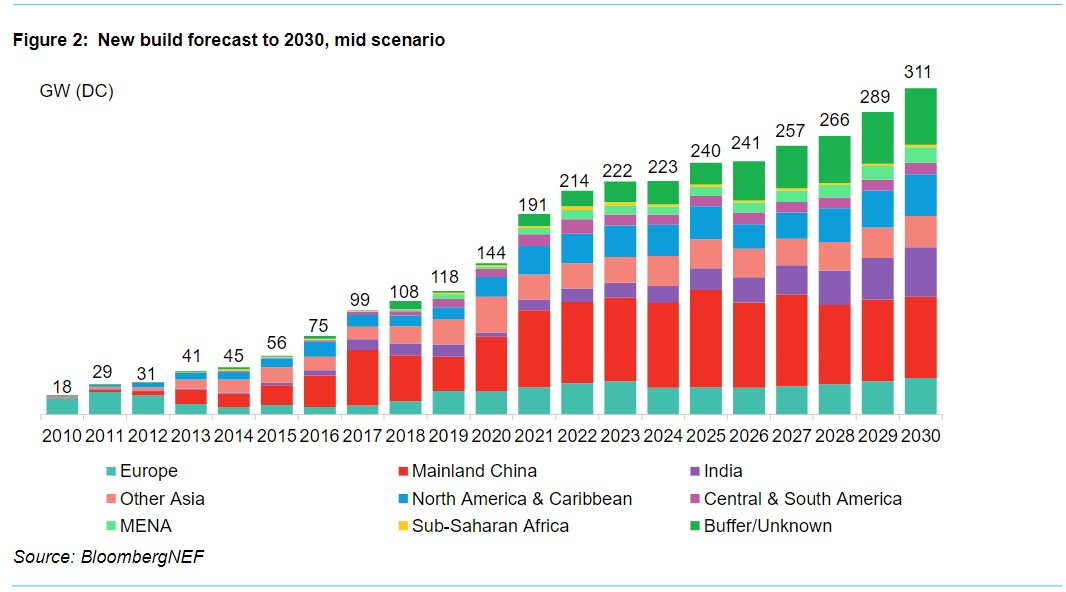
Nowadays nuclear is the most expensive option. That's why they aren't building any more in the US once they finish the two reactors in Georgia that were started in 2009. Existing reactors are relatively low cost to operate, since they use small amounts of fuel compared to coal or natural gas. It's the building of them that costs so much and takes a long time.

On the other hand, solar has grown exponentially as the cost has come down. Even a conservative source like Bloomberg expects it to keep growing.


WolfEyes

Well known member no one knows
Joined
Sep 19, 2018
Messages
4,502
SL Rez
2004
Joined SLU
2009

Beebo Brink

Climate Apocalypse Alarmist
Joined
Sep 20, 2018
Messages
7,256
SL Rez
2006
Dry summer emphasizes threat of climate change to Yellowstone National Park
In June, some areas of Yellowstone National Park received less than one quarter the amount of precipitation compared to the 30-year average.

The lack of rain in June and throughout much of the summer meant the park saw some of its driest conditions since the 1930 Dust Bowl era, said Cam Sholly, superintendent, in a webinar sponsored by the United States Committee of the International Council on Monuments and Sites.
 

Innula Zenovka

Nasty Brit
VVO Supporter 🍦🎈👾❤
Joined
Sep 20, 2018
Messages
24,428
SLU Posts
18459

Evernote link


Beebo Brink

Climate Apocalypse Alarmist
Joined
Sep 20, 2018
Messages
7,256
SL Rez
2006
On Monday, a series of storms put on the parking brakes over northwestern Italy, unleashing rainfall rates never before seen in all of Europe after over 29 inches (742 mm) of rain fell in just 12 hours. In Oman, a rare tropical cyclone dumped years' worth of rainfall, bringing deadly floods to the desert landscape that rarely sees much rain in an entire year.
 
  • 1OMG!
  • 1Thanks
Reactions: Govi and Ryanna Enfield

WolfEyes

Well known member no one knows
Joined
Sep 19, 2018
Messages
4,502
SL Rez
2004
Joined SLU
2009
  • 1Agree
Reactions: Govi