The Holy Roman Empire had a College of Electors, altough the Habsburgs controlled enough seats that it became a rubber stamp for the Habsburg family order of succession. I can see a few marriage allinces turning the Westeros electors into a Stark family tool.
On the other hand, there was an odd number of electors in the Holy Roman Empire (7) and the Habsburgs were much more cohesive than the Weteros great families.
Thanks. I'm a bit confused about how the Westeros electoral college is constituted. So, too, was Ser Davos, who wasn't sure if he had a vote or not, and I'm not sure in what capacity he was voting -- he's Jon's Hand, but the meeting was originally to be a joint trial of Tyrion and Jon, so I share his puzzlement.
Samwell appeared to have a vote, as did Ser Brienne. They later become Arch Maester and Captain of the King's Guard respectively, but presumably they were appointed to these positions by Bran after he was accepted as ruler, so their only official standing at the meeting was as members of the Stark household (which was about to secede anyway), and I don't think the heads of the other great houses brought their maesters and masters of arms with them to the meeting.
So I'm not wholly sure that the electorate is confined to the heads of great houses.
Incidentally, I note that it seems The Citadel have relaxed their requirement that Maesters be celibate or, indeed, that they're fully qualified (unless they admitted Samwell to their ranks through some special, accelerated procedure). I wonder if that applies to the King's Guard, too -- otherwise Ser Pod may find his social life somewhat hampered.
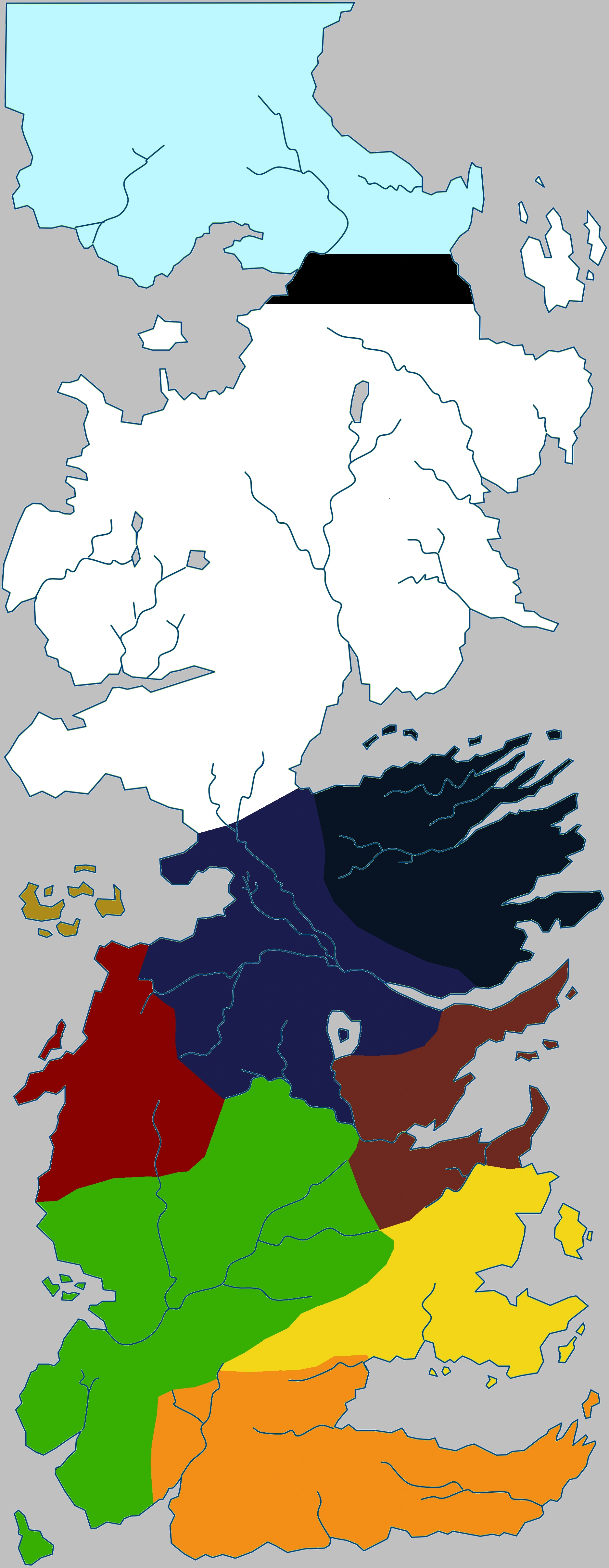
I've been thinking more generally about Westeros and, while it's clearly in many ways based on mediaeval Britain, with Essos representing continental Europe and the Narrow Sea representing the English Channel,, it also has some curious similarities with the USA, at least in that the Head of State and Government is chosen by an electoral college rather than direct election (as Samwell suggested, to general derision).
It's also far bigger than Britain, to the extent that the climate ranges from polar in the North to the arid deserts of Dorne. It now has a culturally broadly similar independent neighbour, The North, and I'm not sure what the status of the territories beyond The Wall is -- does Westeros regard them part of Westeros despite the fact the king's writ does not run there, or are they simply territories unclaimed by anyone other than the Free Folk? Is The Wall a barrier between nations or is it more like the way the Mississippi was once a boundary between the USA and the native American territories?
Dorne provides another US parallel in that, even though it's part of the Six Kingdoms, it's very much a foreign neighbour to the south in many respects, and always seemed more foreign to the rest of the Seven Kingdoms than ever did the Starks' North before Nexit. So it's not unlike Mexico in some ways.
I have to say, I feel rather sorry for the inhabitants of Naath. The Unsullied's only connection with the place, as far as I understand it, was the relationship between the late Missandei and Grey Worm, so the residents of Naath will soon be confronted with the arrival of a sizeable army, who have arrived to protect them, whether they want protecting or not, and who will presumably require lands, food and equipment to undertake this task.
Historically that situation does not bode well for the Naathians, but we shall see (or we won't rather, but we can imagine and hope for the best).
I'm not even going to start to speculate about who was crewing Arya's ship -- multi talented young woman though she obviously is, I don't see how she can sail a full-masted tall ship like that without some expert assistance with the sails, maintenance and navigation.