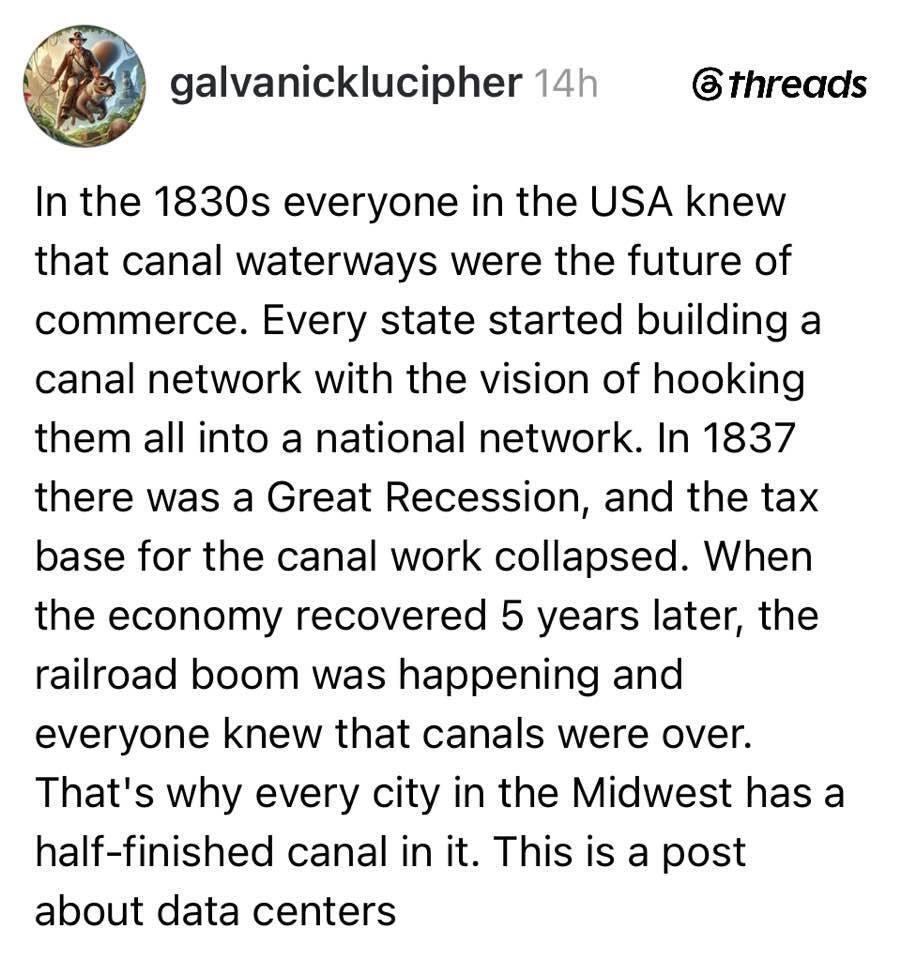
The Quiet Collapse Of Data Center Projects

Cristiano

Cosmos Betraying Fiend
Admin
Joined
Sep 19, 2018
Messages
6,007
SL Rez
2002
Joined SLU
Nov 2003
SLU Posts
35836
Although a couple of high profile new data center projects dominate headlines in the US, there has actually been a dramatic drop in plans for additional ones.


This video explores why major tech companies, particularly Microsoft and Amazon, have suddenly pulled back on their aggressive AI infrastructure expansion after initially committing hundreds of billions of dollars to data center projects between 2025 and 2026 (0:00 - 1:50).
Key takeaways:
  • The initial rush: Driven by the launch of ChatGPT in late 2022, Big Tech companies raced to build massive computing capacity, fearing they would be left behind in the AI arms race (1:58 - 3:10).
  • The DeepSeek factor: The release of the highly efficient DeepSeek model in early 2025 challenged the industry assumption that "more compute equals better AI." It suggested that algorithmic efficiency could be more important than raw hardware scale, leading to a major market rethink (3:23 - 5:10).
Three main problems hitting the buildout:
  1. Demand gap: There is a significant disconnect between massive infrastructure spending and actual revenue generation. Many AI implementations are not yet profitable (5:34 - 6:28).
  2. Power constraints: A global shortage of electrical infrastructure—specifically transformers—and tariff-related supply chain issues have delayed or canceled nearly half of planned U.S. data center projects (6:29 - 7:27).
  3. Economic uncertainty: Companies are becoming more cautious about long-term, non-essential capital commitments as economic outlooks fluctuate (7:27 - 7:45).
Conclusion: The video argues that the AI buildout is not collapsing but rather correcting. While companies like Microsoft are scaling back, others like Google and Meta are absorbing some of that capacity, indicating that the underlying demand for AI infrastructure remains real, even if the initial "fear-based" over-commitment was unsustainable (7:46 - 10:45).
 
  • 1Thanks
Reactions: GoblinCampFollower

Casey Pelous

Senior Discount
VVO Supporter 🍦🎈👾❤
Joined
Sep 24, 2018
Messages
3,243
Location
USA, upper left corner
SL Rez
2007
Joined SLU
February, 2011
SLU Posts
10461
Demand gap: There is a significant disconnect between massive infrastructure spending and actual revenue generation. Many AI implementations are not yet profitable...
In other news, some rocks are hard and many say a lot of water seems wet.
 

Dakota Tebaldi

Well-known member
VVO Supporter 🍦🎈👾❤
Joined
Sep 19, 2018
Messages
9,825
Location
Ohio
Joined SLU
02-22-2008
SLU Posts
16791
Last month my city squashed a proposed hyperscale data center after residents got mad about it. It would have been built in a very poor neighborhood because obviously, plus the guys wanting to build these things are keenly aware that the poorest areas are the most disenfranchised and least able to resist things like this, usually. Not this time, lol.

Interesting (to me), it wasn't Google or Meta or OpenAI or Melon directly who proposed to build this, it was some "equity group". Obviously they intended to lease the compute to one of those, but all the details about exactly who were kept airgapped from the community by this tactic.
 

Caete

Scientist Lady of Science
Joined
Sep 20, 2018
Messages
3,772
Location
20 Minutes into the future
SL Rez
2006
Given Google's track record, I see their scaling back and phasing out on AI happening in 5 years.
Things Google has promoted and cancelled:
  • Google+ (2011–2019): Failed social network attempt.
  • Google Hangouts (2013–2022): Replaced by Google Chat and Meet.
  • Google Allo (2016–2019): AI-powered messaging app.
  • Google Wave (2009–2010): Real-time collaboration tool.
  • Orkut (2004–2014): Early social network, popular in Brazil.
  • Stadia (2019–2023): Cloud gaming service.
  • Nexus Line (2010–2016): Replaced by the Pixel brand.
  • Google Glass (Consumer) (2014–2023): AR glasses.
  • Project Ara (2016): Modular smartphone project.
  • Daydream VR (2016–2019): Virtual reality platform.
  • Chromecast (2013–2024): Streaming devices, with production ending in 2024.
  • Google Reader (2005–2013): Popular RSS feed reader.
  • Inbox by Gmail (2015–2019): Intelligent email app.
  • Google Play Music (2011–2020): Replaced by YouTube Music.
  • Google Domains (2023): Sold to Squarespace.
  • Jamboard (2016–2024): Digital whiteboard app and hardware.
  • Google Currents (2019–2023): Enterprise social network.
 
  • 1Like
Reactions: GoblinCampFollower

GoblinCampFollower

Well-known member
Joined
Sep 20, 2018
Messages
5,398
SL Rez
2007
Given Google's track record, I see their scaling back and phasing out on AI happening in 5 years.
Things Google has promoted and cancelled:
  • Google+ (2011–2019): Failed social network attempt.
  • Google Hangouts (2013–2022): Replaced by Google Chat and Meet.
  • Google Allo (2016–2019): AI-powered messaging app.
  • Google Wave (2009–2010): Real-time collaboration tool.
  • Orkut (2004–2014): Early social network, popular in Brazil.
  • Stadia (2019–2023): Cloud gaming service.
  • Nexus Line (2010–2016): Replaced by the Pixel brand.
  • Google Glass (Consumer) (2014–2023): AR glasses.
  • Project Ara (2016): Modular smartphone project.
  • Daydream VR (2016–2019): Virtual reality platform.
  • Chromecast (2013–2024): Streaming devices, with production ending in 2024.
  • Google Reader (2005–2013): Popular RSS feed reader.
  • Inbox by Gmail (2015–2019): Intelligent email app.
  • Google Play Music (2011–2020): Replaced by YouTube Music.
  • Google Domains (2023): Sold to Squarespace.
  • Jamboard (2016–2024): Digital whiteboard app and hardware.
  • Google Currents (2019–2023): Enterprise social network.
True... they have a LONG history of building products, including some that people like, then cancelling them when they don't contribute enough to their ad revenue. gmail is the only one that really stuck around.
 
  • 2Agree
Reactions: Cristiano and Caete

Cristiano

Cosmos Betraying Fiend
Admin
Joined
Sep 19, 2018
Messages
6,007
SL Rez
2002
Joined SLU
Nov 2003
SLU Posts
35836
This is an interesting take. Admittedly I don't know enough about Quantum computing to judge its validity, but I have followed this woman for awhile.


This video, presented by a digital avatar of Julia McCoy, argues that the current industry obsession with building massive, power-hungry AI data centers is a misguided infrastructure strategy. Instead, she highlights the potential of quantum computing to solve complex problems with a fraction of the energy required by classical supercomputers (0:00-2:46).


Key Takeaways:
  • The Efficiency Gap: A peer-reviewed study published in Science demonstrated that a quantum computer could solve a complex problem in minutes using 12 kilowatts of power—a task that would take a traditional supercomputer like Frontier nearly a million years and vast amounts of energy (0:00-1:07).
  • The Energy Crisis: AI demand is projected to consume up to 17% of U.S. electricity by 2030. Rather than focusing on better math, big tech is investing heavily in new data center campuses, restarting nuclear plants like Three Mile Island, and exploring small modular reactors, despite concerns regarding radioactive waste and environmental impact (1:11-2:34).
  • Hybrid AI-Quantum Stacks: The presenter argues that AI and quantum are not competitors but complementary technologies. AI is ideal for finding patterns in large datasets, while quantum excels at optimization and finding the best actions based on those patterns (3:05-3:21).
  • Real-World Applications: Quantum-assisted AI is already being used today, including:
    • Japan Tobacco’s pharma division for generative drug discovery (3:31-3:42).
    • Forschungszentrum Jülich in Germany, which is coupling a quantum annealer with an exascale supercomputer (3:50-4:05).
    • GE Vernova, using quantum to secure and optimize the electric grid (4:08-4:20).
Strategic Advice for Builders:

  1. Know your workload: If your AI pipeline involves large-scale routing, scheduling, or materials optimization, consider exploring quantum cloud access (e.g., D-Wave Leap, AWS Braket, or Azure Quantum) (4:28-4:44).
  2. Bet on hybrid stacks: Infrastructure that combines classical and quantum capabilities will likely outperform pure classical systems within five years (4:48-5:00).
  3. Monitor policy: Keep an eye on the National Quantum Initiative Reauthorization Act, which recently cleared committee in both chambers to extend federal quantum funding through 2034 (5:01-5:16).
 

GoblinCampFollower

Well-known member
Joined
Sep 20, 2018
Messages
5,398
SL Rez
2007
grrmartin finishing song of ice and fire is the literary equivalent of one of your parents saying "In a minute"
My mother thinks EVERYTHING takes 5 minutes. ...I have many absurd stories about this weird belief of hers, lol. If she does give a larger time estimate than that, it is still guaranteed to be a fraction of what it actually takes. She's often just assumed she must drive twice as fast as I do since I'll tell her the actual travel time and she'll pull some estimate out of nowhere.